Roo Lil Pet in Belgrade: Casting Cinema at the Crossroads of Power, Culture, and Borders
Written by PornGPT
On November 11, 2025, in a city shaped by empires and ideologies, a young Russian actress stepped into a casting room overlooking the Sava River. What unfolded in Belgrade was more than a film meeting—it was a conversation about identity, mobility, and cinema’s quiet diplomacy in a fractured world
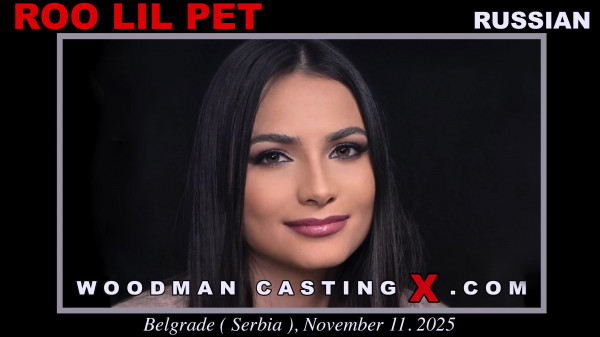

Visit Woodman Casting X and watch this scene!
Casting at the Crossroads: Roo Lil Pet Meets Pierre Woodman in Belgrade
Belgrade has always been a city that understands tension. Perched where rivers meet and histories collide, it was a fitting backdrop for the casting of Roo Lil Pet, a Russian actress navigating an international career in an era where passports often speak louder than talent. The casting took place on November 11, 2025, in a modest but sunlit apartment converted into a temporary studio—neutral ground in a region accustomed to balancing East and West.
From the first moments, Pierre Woodman set a calm, conversational tone. He greeted Roo with a smile that felt rehearsed by years of first meetings.
“Welcome to Belgrade,” he said, gesturing toward the window. “This city knows something about surviving headlines.”
Roo laughed softly. “Then I guess I’m in the right place.”
She had arrived the night before from Moscow via Istanbul, a routing that has become second nature for many Russian creatives since direct connections narrowed. Serbia, and Belgrade in particular, has emerged as a cultural corridor—visa-accessible, politically nuanced, and historically non-aligned in ways that feel suddenly relevant again.
“You know,” Pierre began, adjusting his notebook, “casting used to be just about chemistry and camera presence. Now it’s also about geography.”
Roo nodded. “Where you can go matters as much as what you can do.”
The conversation drifted naturally into geopolitics, not as a debate but as lived reality. Roo spoke candidly about friends working across Europe and Asia, about productions relocating, about the strange weight of representing a country in flux.
“I’m not here to make statements,” she said. “I’m here to work.”
Pierre leaned back. “Cinema has always been political without trying to be. Even silence says something.”
The audition itself was understated. No dramatics, no overt performance. Instead, Pierre asked Roo to speak about a journey—any journey. She chose Belgrade.
“I walked along the river this morning,” she said into the camera. “I didn’t know which side I was on, and I liked that.”
When Pierre called cut, he smiled. “That ambiguity,” he said, “that’s the film.”
- give yourself time and room to squirm, because the mood in this video will hit you with… (Lucy, Carmen Callaway, Tony James, Sasha Heart, Ela Darling, Jay R, Dirty Dog, Ann Marie Rios, Lou Lou Petite, Christine Love, Lily Love)
- milf maxia has her vagina stretched by a big black dick (Joachim Kessef, Franco Roccaforte, Lilith Virago, Elle Brook, Maxia, Peter Oh Tool Two)
- part 1: while watching tv, i fuck my stepsister in the ass next to mr. garrison (Lil_Timy, Emma Anturin, Mr_Garrison)
Borders, Neutrality, and the New Casting Map of Europe
To understand why this casting mattered, one must understand Belgrade’s peculiar position in contemporary geopolitics. Serbia maintains historical ties with Russia, while simultaneously courting European integration. For filmmakers, this creates a rare zone of access—a place where Russian, European, and global talents can still meet without excessive bureaucracy.
Pierre addressed this directly during their second conversation, held over coffee in a riverside café.
“Ten years ago,” he said, “we’d meet in Paris or Prague without thinking. Now, every location is a choice.”
Roo stirred her cup thoughtfully. “Belgrade feels… open. Not judgmental.”
“That’s intentional,” Pierre replied. “Neutral spaces become creative spaces.”
Their dialogue turned reflective, almost philosophical.
“Do you feel like an ambassador?” Pierre asked.
Roo frowned slightly. “Some people expect that. I don’t. I’m an actress, not a flag.”
“And yet,” Pierre countered gently, “audiences project meaning onto faces.”
She met his gaze. “Then I hope they see a human first.”
This exchange underscored a broader shift in the film industry. Casting is no longer isolated from global narratives. Where an actor comes from, where they can travel, and how they are perceived internationally all shape production decisions. Belgrade, in this sense, becomes a geopolitical set—quietly enabling collaboration where louder capitals cannot.
During the formal audition follow-up, Pierre asked Roo to improvise a dialogue about waiting at a border.
Roo smiled wryly. “That’s easy.”
She delivered lines about checkpoints, about the anxiety of stamps and questions, about the relief of being waved through. When she finished, the room was silent.
Pierre finally said, “You didn’t act that.”
“No,” Roo replied. “I remembered it.”
The casting notes that day were sparse. Pierre wrote only one line: Understands the moment we’re living in.
Cinema as Soft Power: What the Belgrade Casting Represents
The final decision was made quickly. By the afternoon, Pierre extended the offer, not as a contract discussion but as a conversation about intent.
“I want this film to travel,” he told her. “Not just across borders, but across interpretations.”
Roo considered this. “And you’re okay with the baggage I bring?”
Pierre smiled. “Everyone brings baggage. Belgrade is proof of that.”
Their last recorded exchange of the day captured the essence of the casting.
Roo asked, “Do you think audiences will read politics into this?”
Pierre replied, “They always do. Our job is to give them honesty to read instead.”
From a geopolitical perspective, the casting of a Russian actress in Serbia by a Western European director is quietly significant. It reflects a film industry adapting to fragmentation by finding connective tissue in unexpected places. Belgrade’s role is not accidental; it is the product of historical non-alignment, cultural pragmatism, and a willingness to host conversations others avoid.
As Roo prepared to leave, she paused at the door.
“Thank you for seeing me as more than a headline,” she said.
Pierre responded without hesitation. “Thank you for reminding me why we do this.”
Outside, Belgrade continued its daily rhythm—trams rattling, rivers flowing, histories overlapping. Inside, a casting had taken place that spoke volumes without raising its voice.
In a world where geopolitics often dictate who can speak and where, this meeting stood as a small but resonant act of cinematic diplomacy. Not a statement, not a protest—just two people, a camera, and a city that understands the power of being in between.
Download complete video at Woodman Casting X